
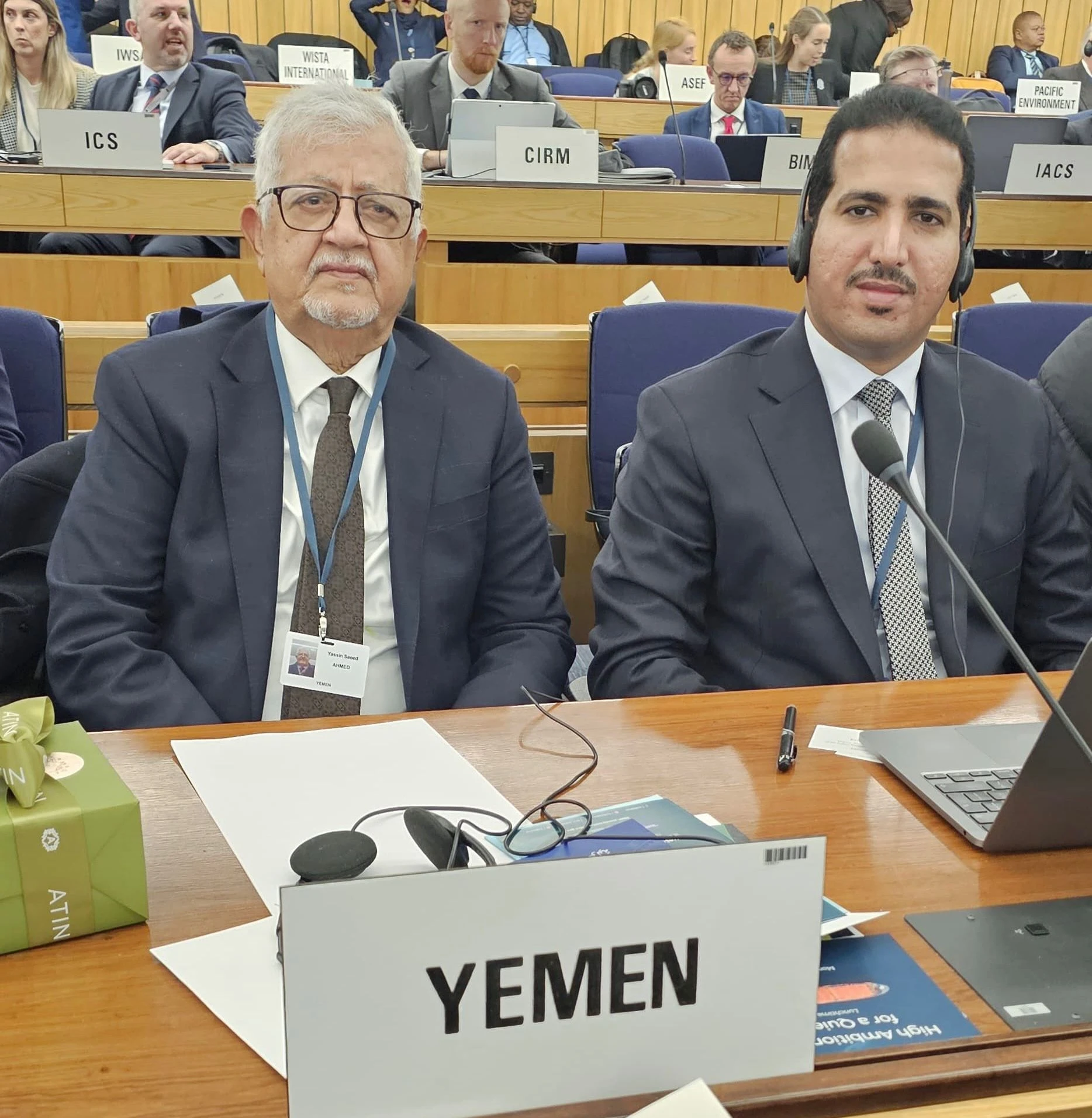
The 34th session of the General Assembly of the organization continues to play a major role in achieving its objectives and implementing its plans to protect international navigation and ensure the safety of ships and international trade across the seas.
Yemen is a country with significant maritime activity that greatly influences its national economy. It has coastlines overlooking the Red Sea, Gulf of Aden, and Arabian Sea, extending for more than 1,500 kilometers. It also overlooks the Bab el-Mandeb Strait at the southern entrance of the Red Sea, through which more than 15% of international trade passes annually.
The Yemeni state has long ensured safe navigation in this maritime region and has fully carried out its responsibilities in this regard.
After the terrorist Houthi militias took control of part of Yemen with Iranian support, they began expanding their terrorist activities by threatening maritime navigation. They have escalated these actions in alignment with the Iranian regime’s policy of expanding its geopolitical and military influence to include maritime corridors in the region.
Over the past two years, the Houthi militias, with logistical support from Iran and using advanced Iranian weapons, have launched repeated attacks on commercial vessels transiting the Red Sea, Gulf of Aden, and Arabian Sea. These militias have launched more than 228 surface-to-surface missiles and drones, targeting over 115 commercial ships. Five ships were sunk, resulting in the deaths and injuries of many seafarers, in addition to the detention of dozens of sailors for many years.
The consequences have been devastating. Chemical cargo, oil, lubricants, and other environmentally harmful substances leaked into the sea, amounting to hundreds of thousands of tons. This caused severe marine pollution, threatening biodiversity, fisheries, and the livelihoods of thousands of fishing families in Yemen and neighboring countries.
The impact of these attacks extended far beyond Yemen’s shores, causing economic and financial losses to many countries, as well as posing a real threat of disrupting economic activity regionally and internationally. According to data from the International Maritime Organization (IMO), United Kingdom Maritime Trade Operations, and United States Central Command, at least 25 attacks on commercial vessels were recorded between August 2024 and June 2025.
These developments confirm the emergence of transnational networks threatening peace and stability in the Horn of Africa and the Arabian Sea.
The Yemeni government confirms that these developments have resulted in:
- The continued flow of weapons, drugs, and illicit materials to the Houthi militias for trafficking and smuggling into neighboring countries, representing one of the most dangerous activities targeting societies, security, and peace in the region.
- The return of large-scale piracy off the coast of Somalia in coordination with terrorist organizations. The latest piracy incident involved the oil tanker “Heba Aphrodite” while en route from India to South Africa, in addition to attempts to hijack liquefied natural gas tankers and gunfire directed at commercial vessels.
Yemen has long been an effective partner in maritime security efforts independently, as well as in coordination with the Arab Coalition, the International Maritime Organization, and international partners. In this context, Yemen committed to implementing the Djibouti Code of Conduct in 2009 and the Jeddah Amendments in 2017.
In this regard, the Regional Maritime Information Sharing Centre (ReMISC) continues to play a vital role in monitoring maritime traffic and disseminating information related to the security and safety of ships.
We highly appreciate the valuable support provided by the European Union Maritime Security Programme through capacity-building activities, technical training, and the CRIMARIO II program, which established the IORIS platform that connects Djibouti Code members, EU naval forces, and maritime security partners through a secure and rapid communications system.
The Republic of Yemen reaffirms its commitment to peace, stability, and the rule of international law, and calls on the international community to contribute effectively to confronting the sabotage carried out by the terrorist Houthi militias and Iran against international navigation in this region, which threatens maritime safety, and to prevent the continued smuggling of weapons and prohibited materials into the hands of these militias, given the danger this poses to الجميع.
We highly value the announcement by certain countries of support for the Yemeni Coast Guard within coordinated efforts with regional allies and international partners to combat piracy, terrorism, arms and drug smuggling, and organized crime—efforts supported and financed by United Kingdom, Saudi Arabia, and other countries.
We hope everyone will support Yemen’s General Authority for Maritime Affairs in its work to ensure maritime safety from pollution and other risks facing ships, enabling Yemen to fulfill its obligations in ensuring that the Red Sea and Gulf of Aden remain peaceful and secure shipping lanes, contributing to further global progress and prosperity.


